

Cisco’s First Global Social Crisis Response Strategy
Problem:
As Cisco’s global digital and social support presence expanded, the organization lacked a centralized framework for identifying and managing emerging social crises across regions, teams, and communication channels.
Potential risks were often fragmented across monitoring systems, operational teams, and regional workflows, creating challenges around:
- crisis visibility and escalation speed
- global coordination and stakeholder alignment
- response consistency across channels and regions
- operational readiness during high-risk events
- real-time communication and action tracking
The organization needed a scalable operational framework capable of detecting emerging issues early while enabling coordinated global response execution across communications, support, legal, and security stakeholders.
My Role:
Crisis Strategy & Workflow Design
Led the strategy and development of Cisco’s first globally integrated social crisis response framework, designing scalable escalation, communication, and operational response workflows aligned to enterprise crisis management practices.
Cross-Functional Leadership & Stakeholder Alignment
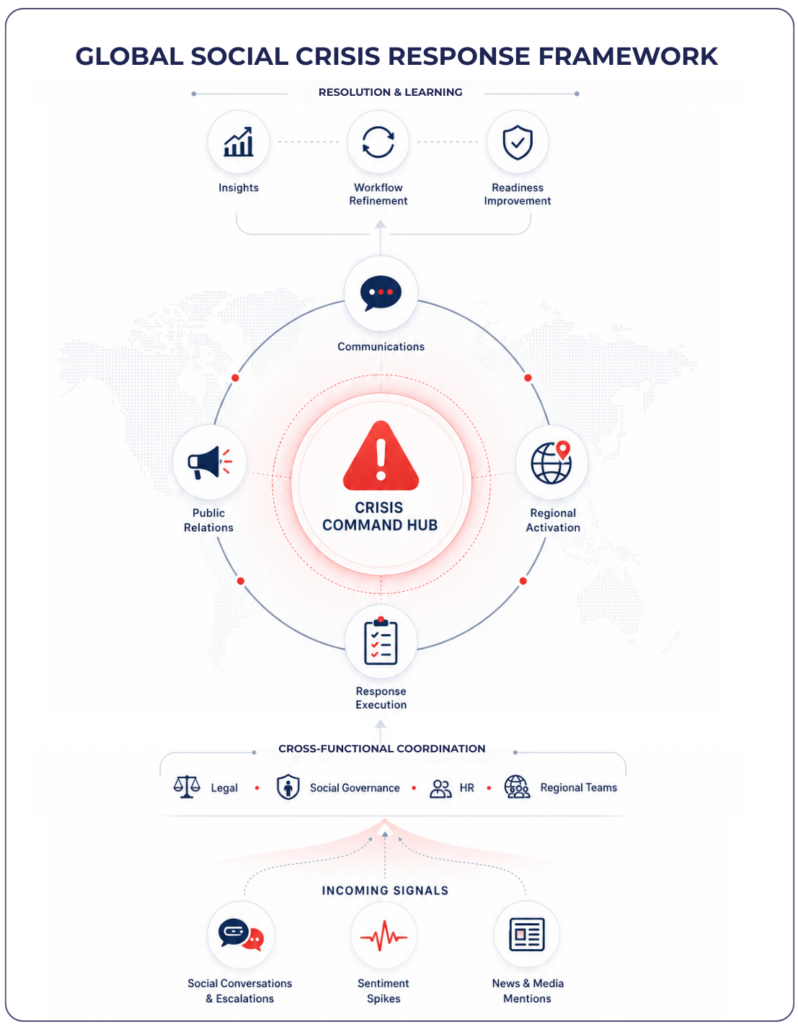
Initiated and led a global task force spanning Security, Legal, Corporate Communications, Public Relations, Regional Teams, Social Governance, Human Resources, Social Listening, and Customer Support to define responsibilities, escalation pathways, and coordinated response procedures.
Crisis Detection & Operational Systems Integration
Developed monitoring workflows and escalation mechanisms integrating Sprinklr social listening, surge detection alerts, and Twilio SMS emergency notification systems to improve real-time visibility and operational responsiveness during crisis events.
Global Enablement & Operational Readiness
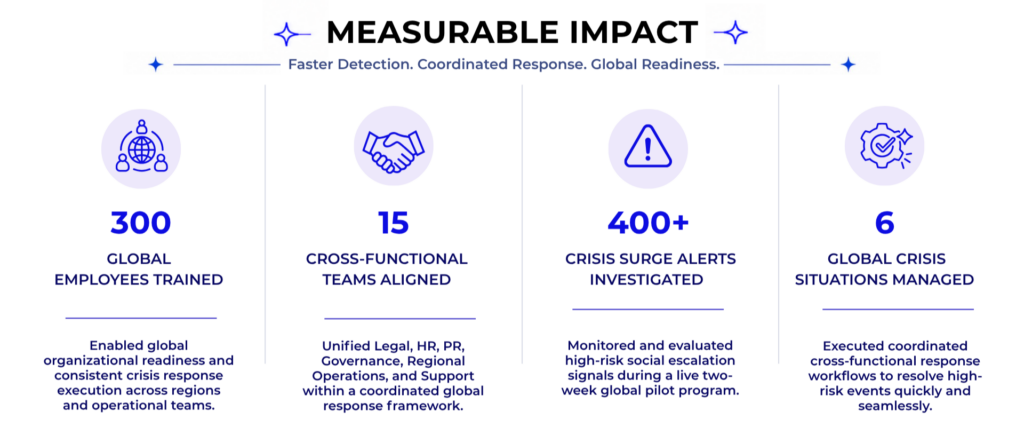
Led global training and operational rollout initiatives to ensure organizational readiness, process adoption, and consistent execution across regions and teams. Facilitated ongoing crisis surge reviews and continuous refinement of escalation and response workflows.
Approach:
Approached crisis response as both a communications and operational coordination challenge, focusing on building an integrated framework capable of connecting monitoring, escalation, stakeholder alignment, and real-time response execution across globally distributed teams.
Designed workflows to balance rapid detection and escalation with structured governance, ensuring that high-risk events could be identified quickly while maintaining clear ownership, communication pathways, and response consistency across regions and functional organizations.
Solution:
The resulting framework established Cisco’s first globally integrated social crisis response system, enabling coordinated monitoring, escalation, communications management, and operational response across enterprise stakeholders and regional support teams.
Core Capabilities
- Global social crisis monitoring and escalation workflows
- Real-time surge detection and alerting systems
- Integrated Twilio SMS emergency notification workflows
- Cross-functional crisis coordination frameworks
- Standardized communications and response pathways
- Global operational training and enablement processes
- Continuous crisis review and workflow refinement mechanisms
Outcomes:
The initiative established a scalable operational foundation for global social crisis management, improving organizational readiness, cross-functional coordination, and response consistency across high-risk customer and brand events.
The framework enabled faster identification and escalation of emerging issues while creating clearer communication pathways and more coordinated global response execution across support, communications, security, and operational teams.
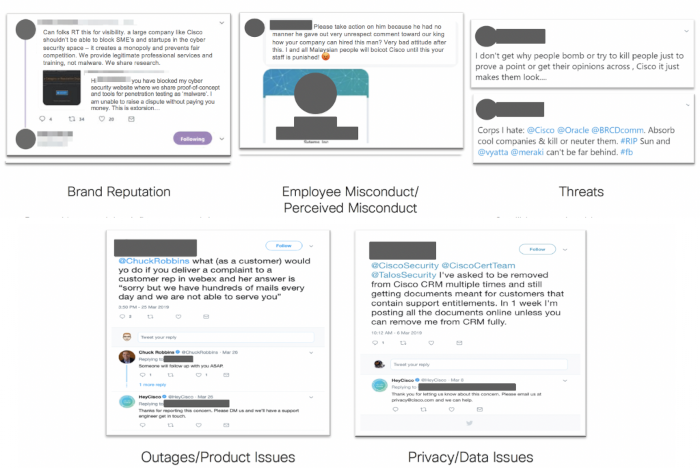
Crisis Scenarios Identified With Surge/Threshold Alerts